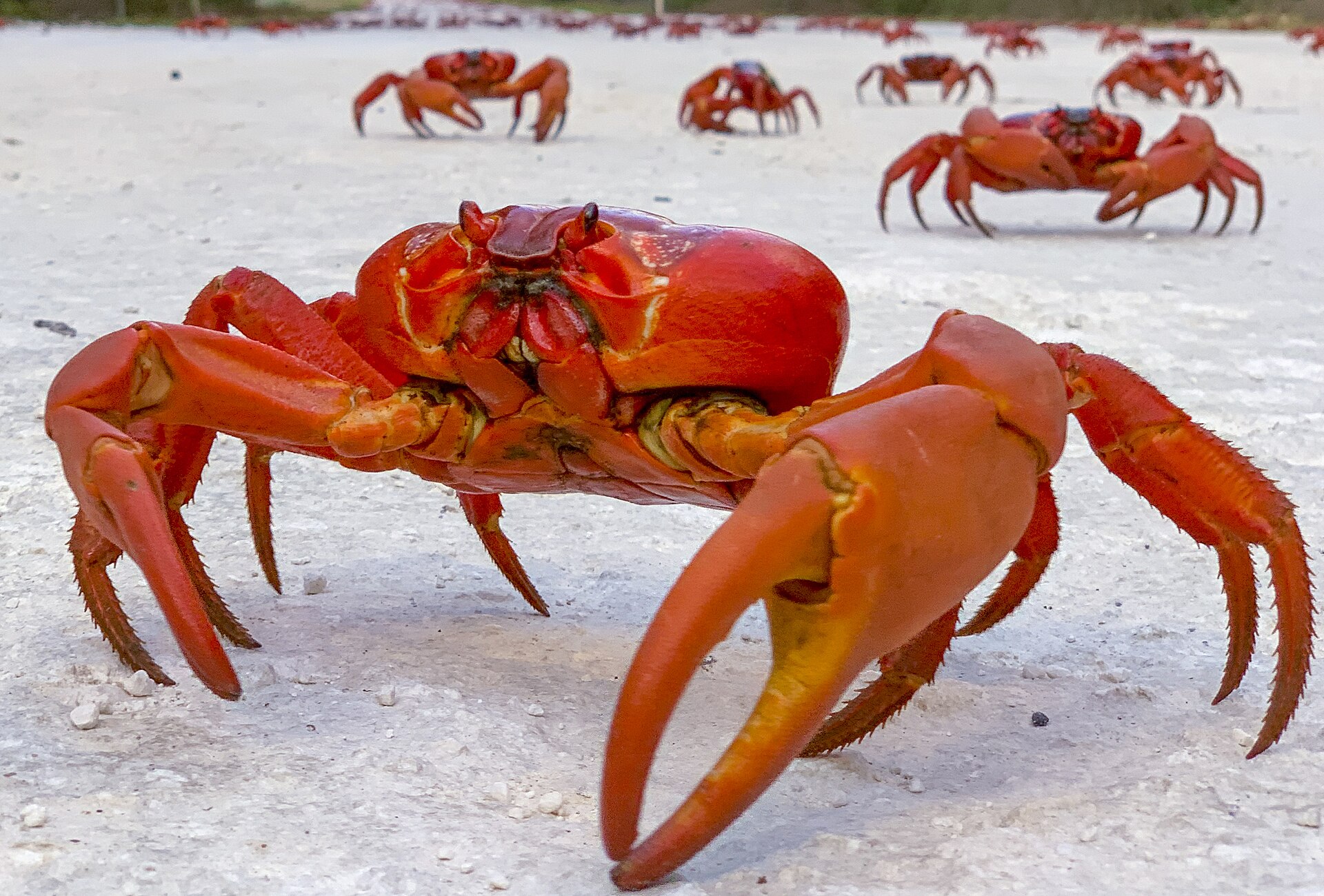
Christmas Island is a speck of rainforest-covered limestone in the Indian Ocean, closer to Java than to mainland Australia. For most of the year its red crabs live quietly in the forest, sheltering in burrows from the sun. Then, when the first real rain of the wet season arrives, almost all of them set off at once for the coast. Roads, gardens, car parks and the steps of the island’s few buildings turn red, and the island organises itself around them for a few weeks.
In short: The red crab migration on Christmas Island is one of the largest animal migrations on land. In 2026 it started in mid-November, and the next possible spawning dates are 5–6 December 2026 and 2–3 January 2027. Exact timing depends on rain, the tide and the moon, so plan a stay of several days rather than one night.
At a glance
- Where: Christmas Island, an Australian territory in the Indian Ocean
- When: usually from October or November, with spawning in the last quarter of the moon; this season the possible dates are 5–6 December 2026 and 2–3 January 2027
- Getting there: QantasLink flights from Perth, twice a week
- Best viewing spots: Drumsite, Flying Fish Cove, Ethel Beach, Greta Beach
- Bring: sturdy shoes, patience and a car hire booked well in advance
What actually happens
The migration happens in stages. The males leave first and walk down to the lower terraces near the sea, where they dig burrows. The females follow about two weeks before spawning, and the crabs mate in the burrows. The males then head back up to the forest, while the females stay behind for roughly two weeks to brood their eggs.
The spawning itself is precise. Before dawn, on a receding high tide during the last quarter of the moon, the females gather at the shoreline and release their eggs into the sea. This can go on for five or six nights in a row. If the rain comes late, the crabs simply wait and go a month later, which is why every date on this page comes with a caveat.
About three weeks after spawning, the surviving larvae come back out of the sea as tiny crabs and climb up into the forest. In most years only a few of them make it, but every so often there is a huge return and the shore is covered in baby crabs.
The 2026 season so far
This season the crabs moved in mid-November 2026, when news crews filmed roads covered in them on 14 and 15 November. Parks Australia puts the population at more than 100 million crabs, roughly double the figure from the early 2000s, which the park staff see as a sign that the conservation work is paying off.
Roads, crab bridges and tunnels
The island takes the migration seriously. Sections of road close for part or all of a day during the peak, often with little notice, and updates go out on public notice boards and local radio. Low walls along the roadsides steer the crabs into tunnels under the tarmac, and there is a purpose-built crab bridge over one of the busiest roads. The crossings are also some of the best places to watch the flow of crabs without getting in the way.
Seeing it for yourself
The usual places to watch are Drumsite, Flying Fish Cove, Ethel Beach and Greta Beach. You can park and walk among the crabs, but slowly, and you have to watch every step. Drive the same way: slowly, and only where the roads are open. The best way to see the spawning is to be at the shore before first light on the predicted nights.
Getting there takes some planning. Since November 2025 the Perth route has been run by QantasLink instead of Virgin Australia, with flights on Mondays and Fridays. Seats, rooms and rental cars on the island are limited and sell out early for migration season, so book everything at the same time. Most of the island is national park, and the rest of the year is worth a visit too, for rainforest walks, birdwatching and snorkelling in Flying Fish Cove.
Sources and last check
Dates and details were checked in November 2026. The migration follows rain, the tides and the moon, so confirm on the official pages before you travel.
- Christmas Island Tourism Association – red crab migration and possible spawning dates
- Christmas Island Tourism Association – flights from Perth
- Parks Australia – Christmas Island National Park
Questions people ask
When is the Christmas Island red crab migration in 2026?
The migration began in mid-November 2026, after the first wet-season rains. The Christmas Island Tourism Association lists 5–6 December 2026 as a possible spawning date, with another window on 2–3 January 2027, give or take a day.
Where is the best place to see the red crabs?
Drumsite, Flying Fish Cove, Ethel Beach and Greta Beach are the usual viewing spots, along with the crab crossings and the crab bridge on the main road.
How do you get to Christmas Island?
By plane from Perth in Western Australia. QantasLink took over the route from Virgin Australia in November 2025 and flies twice a week, on Mondays and Fridays.
Can you walk among the crabs?
Yes. You can park and walk carefully among them on their way to and from the beach, as long as you follow the signs and the advice of national park staff.
Photo: Chris Bray, CC BY-SA 4.0, via Wikimedia Commons
