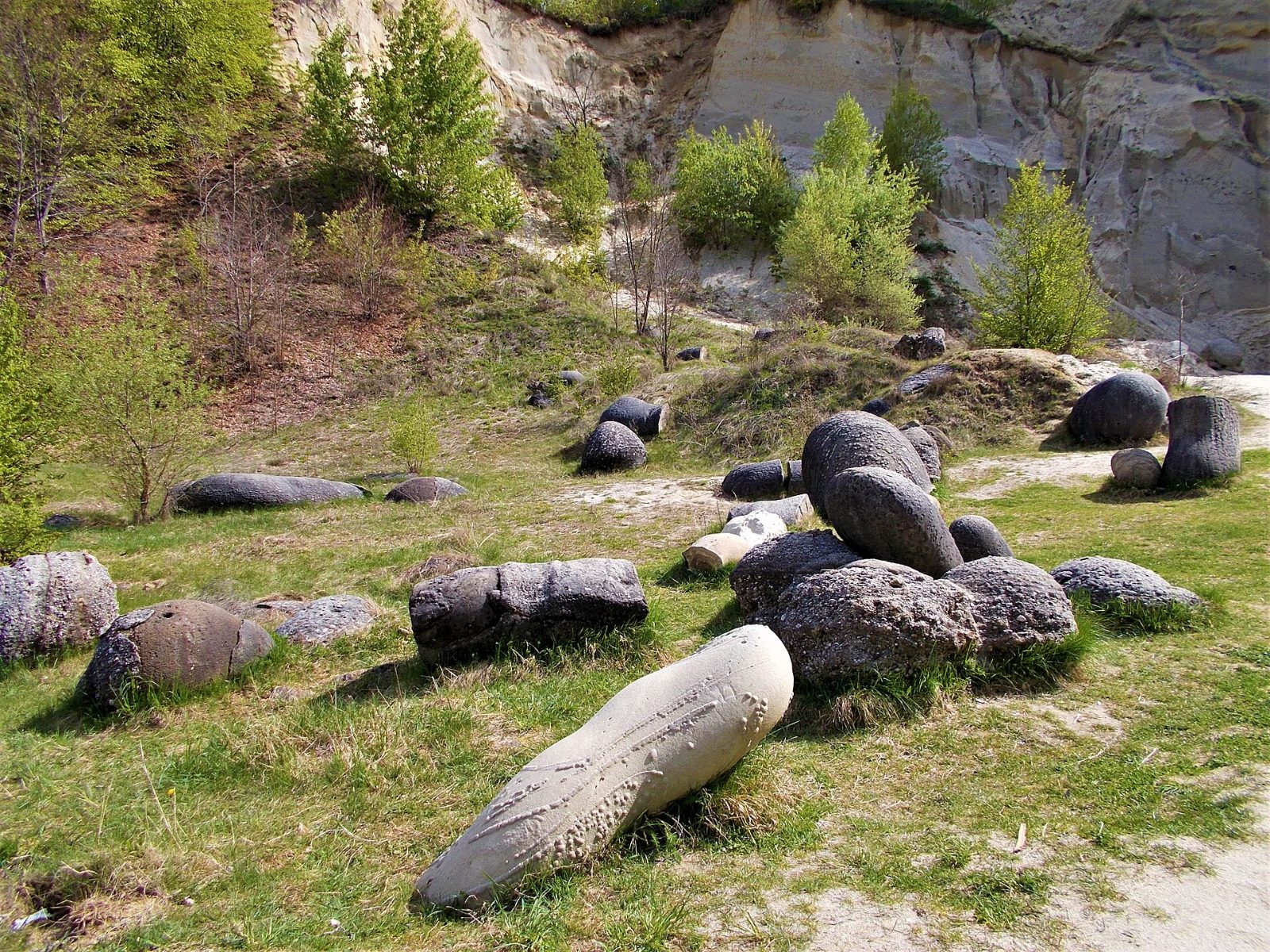
Locals in Costești have a running joke: leave a stone in the rain long enough and it will have babies. They are talking about the trovants, lumpy grey boulders that sit in an old sand quarry in Vâlcea County and look as if someone poured them out of a bucket. The joke is not entirely wrong.
At a glance
- Where: Costești village, Vâlcea County, Romania
- Nearest city: Râmnicu Vâlcea, about 38 km away on the DN67 road towards Târgu Jiu
- Time needed: 1 hour
- Best time: April to October; a visit after rain shows the stones at their darkest and shiniest
What you actually see
Rounded stones, dozens of them, from the size of a loaf of bread to the size of a small car. Some are smooth, others are covered in knobbly bumps, and many have smaller lumps budding off their sides. Up close they feel more like rough concrete than rock.
The reserve itself is small and you can walk around it in under an hour. It is rarely busy, which is part of the charm. If you are driving between Râmnicu Vâlcea and Horezu, it is an easy stop, and an odd one.
So, do they grow?
In a way, yes, though far more slowly than the legends suggest. Trovants are a type of sandstone concretion: a hard core surrounded by layers of sand cemented together by calcium carbonate. Water seeping through the sand carries dissolved minerals, and over time these minerals bind more grains to the outer shell. That is why the stones look as if they swell and “sprout” new bumps.
Geologists date the sand layers that hold them to millions of years ago, when this part of Romania lay under water. More recently, scientists studying stones like these found that bacteria living in them help produce the natural cement that holds the sand together, which adds a living ingredient to the old folk tale.
The other legends are more fun than factual. You will hear that trovants move on their own or “give birth” to new stones. They don’t move, but the small concretions that break off the large ones do look remarkably like offspring.
Things to look out for
- The main field of trovants: dozens of large stones scattered along the reserve’s paths, many taller than a person.
- Cross-sections: look for broken trovants that show the concentric layers inside, like the rings of a tree.
- The quarry wall: some stones are still half-buried in the sand, showing how they were hidden before being exposed.
Please don’t climb on the stones or take pieces home. The reserve exists because so many trovants were removed in the past.
Getting to Costești
Costești lies on the DN67 between Râmnicu Vâlcea and Horezu. From Bucharest, the drive takes about 3.5 to 4 hours; from Sibiu, around 2 hours. There is parking next to the reserve. Public transport is limited, so a car is by far the easiest option.
A few practical notes
- Wear shoes with good grip. The sandy paths can be slippery after rain.
- Come in the morning or late afternoon for softer light on the stones.
- Combine the visit with nearby sights to make a full day of it.
While you’re in the area
- Horezu Monastery: a UNESCO World Heritage monastery a short drive away, the finest example of the Brâncovenesc style.
- Horezu pottery: the village is famous for its hand-painted ceramics, also on UNESCO’s list of intangible heritage.
- Bistrița Monastery and the Cheile Bistriței gorge, just north of Costești.
Frequently asked questions
Do the trovants really grow?
Yes, very slowly. Trovants are sandstone concretions, and when rain soaks into them, minerals in the water can add new layers of cemented sand. The growth is tiny, only a few centimetres over a very long time, so you will never see it happen.
Where can I see the trovants?
The best place is the Trovants Museum Natural Reserve in Costești, Vâlcea County, an open-air reserve in a former sand quarry in southern Romania.
Is the Trovants Museum worth visiting?
Yes, if you like unusual geology. A visit takes about an hour and combines well with other sights in Vâlcea County, such as Horezu Monastery.
More places you should see
Featured photo: Nicu Farcaș, CC BY-SA 4.0, via Wikimedia Commons.
Facts checked in November 2026. Access and visiting conditions can change, so check locally before you travel.